Black Rhino Game Reserve Research (with photos added July 2001)
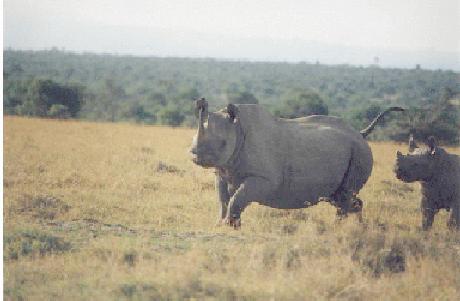
We now come to the original reason for my whole African saga in the first place: 2 weeks as an Earthwatch volunteer at the Sweetwaters Rhino Reserve in Kenya. Earthwatch is a U.S.-based organization that accepts submissions from scientific research projects around the world, looking for volunteer manpower. It then advertises these projects on the web and in its magazine. When a volunteer applies and is accepted for a particular project, Earthwatch charges the volunteer a (sometimes substantial) fee to cover the cost of food, accommodation, research, and overhead, while taking a cut themselves, naturally. Still, they provide opportunities that would be difficult to attain otherwise, which was why I was joining Team 0 (the newly added on team of 10 volunteers) that would be kicking off the latest summer of black rhino research under Dr. Alan Birkett.
I should warn the reader ahead of time that the relative routine of 14 days of research does not tend to make for fascinating reading, but at least one interesting thing happened every day. It is those moments (with accompanying photography) that I have tried to capture here.
Nairobi
Departure - June 7
Training - June 8
First Rhino Patrol - June 9
Elephant Dung Density
- June 10
Tree Damage - June 11
Morani's Compound and
Elephant Encounter - June 12
Tagged Tree Measuring -
June 13
Second Rhino Patrol - June
14
Sweetwaters Tented Camp
- June 15
Ol Pejeta Lodge - June 16
Tree Plots - June 17
The Other Volunteers -
June 18
Morani II, and Campfire
with Annie - June 19
Closing
Ceremonies - June 20
Homeward Bound - June
21, 22
I had every intention of kicking off my final African adventure with a smooth and meticulously organized morning. After all, I was back in civilization and back in control... right? Alas, had I learned nothing from the preceding 4 weeks? It all began with a luxurious breakfast at the Oakwood Hotel. That completed, I went downstairs to where a small desk in the front hallway served as, well, the front desk, I guess. I had already fished a $50 US bill out of my money belt to pay for the one night. Unfortunately, the brown leather of the money belt (combined with the perspiration of carrying one's life through equatorial regions) had imparted a few tinted water marks on the bills. This was enough for the front desk lady to consider the bill unacceptable. A second bill (my last) was retrieved from the same belt. It too had some smudges, but these were less noticeable. She carefully looked over the bill, then looked at me, and then at the bill again. The local security man was summoned. Uh, oh. Fortunately, he was only to be a trusted messenger boy: "Take this to the bank. If they accept it, then this guest is free to go." He was back in a few minutes, to announce that my money was good and my account was settled. Phew! (I made a mental note to speak to Pierre-Michel about where he was leaving the bills to dry after taking them from the printing press... - Hey, I'm kidding!)
The Oakwood had been a bit on the pricey side, but I chose it for two reasons: (1) it was a known entity (my having stayed there prior to leaving for Tanzania); and (2) it was right next door to the very much more expensive Fairview Hotel where the volunteer team was to rendezvous before being whisked away to the plains of Kenya. I still had lots of time, so I wandered off to find a post office and send some letters. I was back in the lobby of the Fairview with 30 minutes to go, so I sat and watched for other foreigners who looked like they might be on a similar mission. The minutes ticked on. I remained alone with my book. Finally, zero hour - 11AM - and still no-one else in sight. Had I been waiting for a local, I might not have been the slightest bit surprised, but these were Americans and Europeans - surely amongst the nine others... Something was wrong. Very wrong. To this day, I'm not really sure why I thought that the hotel that I had been sitting in was the Fairview Hotel. I suppose it must been a compilation of small assumptions, research errors, poor signage, and wishful thinking. Suffice to say that I was in the wrong place at the right time. Fighting off panic, I quickly sought out the concierge of the Stanley Hotel (where I had been lounging for the last half hour). He immediately found me a taxi, and we made top speed on the five minute ride to the Fairview several blocks away.
I need not have been concerned. Sure enough, the other volunteers were all gathered in the lobby of the Fairview. And sure enough, it was 12:30 before the 12-seater matatu showed up to carry us to Nanyuki, two and a half hours (and one hemisphere) away. Of course, the term 'twelve seater' means different things to different people, as I had already discovered on my trip to Tanzania. Ten volunteers, a driver, and James, our guide from the research centre, added up to 12. Then there was the luggage for two weeks of ten volunteers. We got to know each other very quickly. There was John (economics professor from Colorado), Liz and Ashley (both chemists from England), Yvonne (a zoo docent from Texas), Leslee (Interior Designer from Florida), Stuart (an Australian IT professional based in Nevada), Catherine (from New York), Marian (from Washington state), and Becky (a museum curator from upstate New York).
We are met in Nanyuki by Dr. Alan Birkett, the head of the research project. After a quick lunch in a pleasant cafe (whose menu contained various western diner-style choices, all suffixed by "with chips"), we tossed the luggage into a pickup truck (along with a sizable quantity of beer), and crammed the now thirteen persons into an even smaller Toyota LandCruiser - four in the front seat, four in the back seat, five in the very back. Only in Africa... Fortunately the drive to the research centre was a shorter one - half an hour or so.
The Sweetwaters Game Reserve is primarily for black rhino, but contains many other animals, including elephant, giraffe, hippopotamus, lion, zebra, buffalo, several antelope species, etc. There is also a chimpanzee sanctuary within the reserve and a large ranch to the north. We are staying at a research centre which has had two round four-room huts constructed for our arrival. The huts are concrete with thatched roofs and very pleasant. There is also a central building with more rooms, showers, and a kitchen and dining area. Already present at the centre are Kathy, a thoroughly charming graduate student focusing on giraffe research, and Jason, a Computer Science graduate who developed some of the software that we will be using over the next two weeks. They are both are from Manchester, and are two of the nicest people you could meet on any continent.
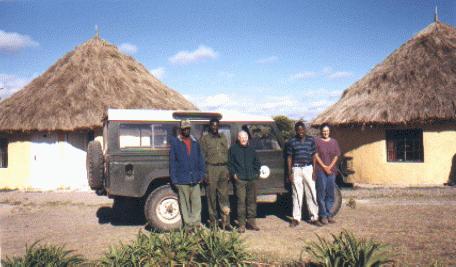
We have divided ourselves into five pairs. John and I form Team 5, which suits me just fine. We will spend the next two weeks working in rotation, with each team pair getting a different task every day. Our first job is to go off into the bush with Alan and some guides to learn the basics of the GPS location finder, tree measuring sticks, transect-walking, and how to use the PalmPilots that will store our findings. We must also learn to distinguish various plant species, ant species, elephant versus rhino versus giraffe damage to trees and bushes, and elephant droppings versus rhino middens; all essential to our work over the next two weeks. The main plants we have to know are Acacia drepanalobium (Whistling thorn - named for the noise it makes on a windy day), and good old Euclea divinorum - the Magic Guarri bush from my South African field guide course. I am already ahead of the game!
On our first exploratory walk to a sample tree plot, we saw bushbuck, waterbuck, warthogs, martial eagles, a hamerkop bird, and two hippos in the river. We were soon to learn that such a incredible variety of wildlife virtually within spitting distance was to be the norm for the next two weeks. Except for movement within the research compound (and even then, only during the daylight hours), it is not safe to walk anywhere without an armed guard. Poachers, lions, elephants, hippos, and buffalo all pose infrequent but very real dangers on the reserve.
On our return from the bush, a few of us dropped over to the Ol Pejeta Lodge, a luxury estate situated inside the reserve which served as the accommodation for some previous high profile owners of Sweetwaters. It has a small but very welcome swimming pool around the back where we could go and escape the hot afternoon sun. (More about this historic residence later.) After a lovely meal of baked Nile Perch, we spent the first of many nights gathered around the camp fire before retiring to our huts.
The first assignment for John and me is to join a rhino patrol. To be allowed to maintain black rhino on a game reserve, certain conditions must be met, as laid down by the Kenyan Wildlife Service. A two-man patrol must be dispatched every day to look for black rhino. As soon as they have seen one and identified it, their job is done for the day. If a particular rhinoceros has not been seen for thirty days, a special patrol must be sent out to find that individual rhino. Joining the rhino patrol means an early start, and we are up and at breakfast at 6:30. At 7am, the patrol arrives at the research centre to say that they have already found Tuliva (female # 8) with her calf, so we rush off to try and find her again. We depart on foot, moving single file through the bush. A tracker (armed of course) leads the way while another tracker brings up the rear.
After about an hour we have found a recent bedding site but have not seen her. By 9am we are at the airfield and figure out that she must have come this way. Sure enough, a set of mother and calf footprints are found, which we carefully measure and record in the PalmPilot. Thirty minutes later, a radio call from another tracker announces that they were spotted off to our left and we quickly move off in pursuit. We join up with the other tracker and now the five of us continue to search the bush. Finally, at 10:15, our guide spots them close by and backs us up very quickly. Note that your guide seeing something is not the same as you seeing something. These experienced trackers will detect all kinds of wildlife long before you are even aware that anything is there. This is generally a good thing, but so far, our only evidence of the rhinos' presence was the tracker's rear end suddenly reversing at us instead of moving forward.
At this point, John and I still have very little concept of what level of danger is associated with this activity. Black rhino are known to be elusive but aggressive, and a mother with calf is likely to be more so. The primary objective is to see the wildlife before the wildlife sees you. From a sensory standpoint, the odds are clearly stacked in their favour. A rhino will normally only intentionally charge you if you have surprised it at close quarters or have threatened it in some way. A more likely danger is that when a rhino detects any sign of man or predator (either by smell or warning calls from birds), it will choose a direction and run. The trajectory might be away from you or towards you, it matters little to the rhino. Their eyesight is poor, but trampled bushes are more a result of the startled beast ignoring obstacles rather than not seeing them.
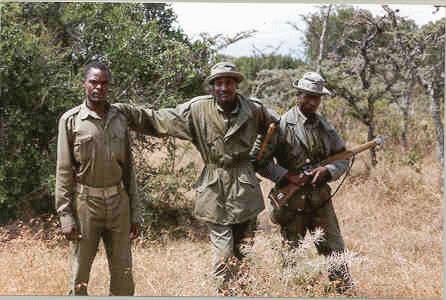
Once we are at a safe distance, two of the guides go off to try and find a good viewing spot, but the swirling wind makes it impossible to stay downwind of Tuliva's sensitive nostrils, and she dashes off with her calf moments later (away from us this time). We hear her departure but still see nothing. We check out the recently used midden and bedding site, capturing the location coordinates on the GPS and then downloading them straight into the PalmPilot. Technology! We are underway once more when another radio call tells us of an elephant in our area. We had no sooner decided to look for it then our guide starts pointing, shouting, and jogging into the bush on our right. It is our rhino family once again, and this time I get a glimpse of a light grey rump disappearing into the thick brush. John says he saw two of them but still no heads.
We next headed over to a nearby reserve entrance gate, opening on to an area called Simba (lion) plain, to see if Tuliva and calf would cross the road, thereby giving us a chance to see them clearly, but they fail to appear. A decision is made to head north into the overlapping territories of two male rhinos: Jupiter and Job. It is said that Jupiter is a rather nasty character who has been known to follow people, rather than the other way around. We encounter zebra, six eland, and a few giraffe (some as close as 30 metres/yards or so), but no great horned beasts. About an hour later, one guide spots a bush moving in the distance. Something is clearly eating, and our guard goes in to investigate. Suddenly we hear a snort, confirming that we have an elephant before us. Sure enough, after a few minutes, the ears, head, and back come into view just above the Euclea bushes. We waited for a while to get a better view, but our lone friend ended up choosing the opposite direction, so we set off again. In all, we figure we put in about 16 km (10 miles) on our first day, returning to the research centre around 2pm.
After dinner some of us decided to visit the Sweetwaters 'Tented Camp", a resort of sorts that caters to the rather well-heeled tourist. It has a great watering hole which is brightly lit at night, where a large number of animals (apparently oblivious to the intense arc lights) come for a drink. I didn't visit the tented camp myself until the second week.
Elephant Dung Density - June 10
Today's assignment was to walk along predetermined transects and count elephant dung piles within a specified number of metres of the path. This may sound like mundane or unpleasant work, but it was actually very rewarding, if for no other reason than the fact that we were still hiking through savannah teeming with wildlife. Elephant dung piles give us a good indication of where the elephants go and how much they eat in that area. The dung as a very distinctive look, occurring in piles of straw-packed lumps about the same shape and size as a large can of tomatoes. The colour and moisture level of the dung is an immediate indicator of its age, a fact whose importance became apparent a few days later.
We were assigned one of the most popular guides for today's work. His 'christian' name is Elijah, but he is known by his native name of Kariuki (some call him Karaoke!). Kariuki was more cautious than his trench-coated counterpart of the day before. One gets very good at judging the level of alertness required for moving through the bush, based on how your guide is holding his .303 rifle. We were told that each rifle holds three bullets, and that the first two were intended to be fired over a charging animal's head. Fortunately, we didn't encounter anything more dangerous than waterbuck, zebra, warthogs, and four ostriches. Some months before our arrival, some researchers had surprised an elephant hidden by some bushes while they were out on a walk. It is hard to imagine an elephant hidden by a bush until you actually see it, as we had the day before. The researchers and guide ran, but the frightened elephant charged after them. The guide tried to fire a shot over the elephant's head, but his rifle had jammed. Kariuki was nearby and he raised his gun to fire off a warning shot. Sadly, the trigger was pulled before the gun was high enough, and the bullet struck the elephant's head in just the wrong place (or right place, depending on which end of the tusks you were on). It killed the elephant instantly, which is practically unheard of for such a small calibre bullet. The Kenyan Wildlife Service came in to investigate and cleared the staff of any negligence - it was simply a tragic accident.
We had to forego any visits to the Ol Pejeta Lodge swimming pool today - apparently the son of Kenya's President is in residence there for a few days. One of our cooks, Joseph, has noticed my attempts to pick up as much Swahili as possible, and so at tonight's campfire he decided to begin tutoring me. Since his English is non-existent, it is a slow process, but occasionally one of the other staff will throw in a translation.
It feels like we are already settling into something of a routine here. This morning John and I got a lift with William out to Ol Pejeta dam to do a tree damage survey. William is a 'retired' field guide that has come back to work for a while, especially given the influx of volunteers on the reserve. His experience is highly respected around here - his most famous escapade being a life or death struggle with a large lion. He had been on a team to track down a lion who had become a problem to the local farmers and villagers. They managed to find and shoot the lion, but as William moved forward to confirm that the animal was dead, another lion sprang from the bush and attacked him. He was knocked down and ended up with most of his arm between the attacking cat's powerful jaws. He had almost given up hope when he suddenly remembered the large knife that he wore on his belt. He managed to reach it and survived the ordeal with a badly broken arm, some severe lacerations, and a renewed respect for the savanna in which he worked.
The drive out was punctuated by warthog families darting out all along the route. Heavy rains last year are suspected as being a contributing factor to the large warthog litters (at least four per family, as opposed to the usual two or three). I had already learned in South Africa that male warthogs have two pairs of 'warts' on their faces, while females have one pair, however I had not appreciated (until I handled some skull parts) that all warthogs have two pairs of tusks. Both the upper and lower jaw have two tusks that nest together like scissors - in fact they are often used that way. Anyway, they are quite comical to see as they dash off single file with their tails standing straight up in the air. They often live in abandoned aardvark holes which they convert to their own burrow specifications. Aardvark holes are everywhere, and pose a serious hazard to people walking across the grasslands without watching their step.
Today's work required mapping out a grid within a specific plot area, and then searching for trees within that grid that show signs of damage from rhino, elephant, or giraffe. The damage was then classified by type and by suspected animal perpetrator, and the tree's height and trunk width were measured. The grid and measuring tasks were complicated by the fact that we forgot to bring the tree measuring stick - a telescoping device for calculating tree height, and the 30 metre winding tape housing fell apart in the field. However we did manage to do a full days work, and once again, it was not as dull as it might seem. At one point, the three of us were debating over whether a particular lost branch should be classified as tree damage, when we turned to see no fewer than 22 giraffe standing about watching us, with an equal number of zebra close by. Giraffe are shy but curious creatures, and clearly they found our work fascinating.
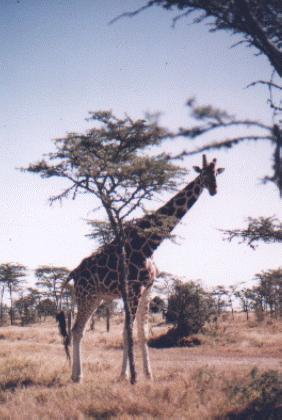
When our grid survey was complete, we decided to perhaps look in on another team not far from where we were. As we headed off, we came upon about a dozen elephants cooling off in the river some distance away. After watching them for a while, they eventually moved on and we did the same. We were now in the full heat of the day, and a passing LandCruiser changed our visiting plans, heading back home instead.
In the afternoon, I made the unpleasant discovery that my airline tickets are nowhere to be found. I suspect that they were left in Arusha. Attempts to call the hotel end up providing a whole new lesson about how things work in Africa. The Naaz hotel has a phone number in the Lonely Planet that does not connect to the Naaz Hotel. In fact, every number I try (even to major hotels) end up either out of service or somewhere else. Calling the operator or 'directory assistance' resulted in a completely different number but the same result! Finally, I get someone who speaks Swahili to pick up another line, and we manage to find someone who happens to know this month's phone number for the hotel. Thus an ongoing saga for the return of the tickets began.
Tonight's campfire was graced by a visit from Annie Olivecrona, the manager of the Chimp Sanctuary, and one remarkable woman. Annie is someone with a thousand fascinating stories from her incredible experiences with animals in Kenya. Originally Scandinavian, she came to Africa to help round up game for the world's first safari parks. Back then you would drive a pickup alongside a giraffe, lasso it, and then put one person on each leg to try and subdue it for travel to parts unknown. She has since come to be recognized as a premiere animal wrangler, and has worked on all the major movies shot out there, including "Out of Africa". Her stories of lions, snakes, and flying a bush plane full of chimpanzees (wearing seatbelts of course) are fabulous. She also gave us some unique insights on the UN High Commission on Refugees, the World Wildlife Fund, and more.
Morani's Compound and Elephant Encounter - June 12
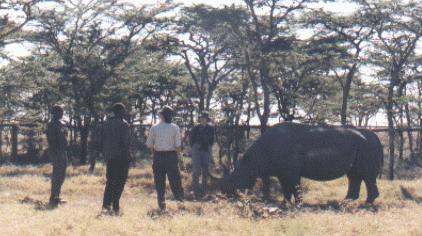
Our assignment for today was unusual, given our rhino encounters on the first day. Sweetwaters has a compound devoted to Morani, an adult black rhinoceros who was orphaned as a calf and has grown up to be domesticated. Part of the research involves spending the morning with Morani (Swahili for "young warrior"), following him around, and noting everything that he does - what he eats, when he moves, where he marks his territory (by spraying urine), etc. Given the way we were treating this species the day before, it seemed strange to be able to walk up to him, stroke his head, and feed him some asparagus fern - a favourite. Of course the photo opportunities are great too. The local tour companies are well aware of this, and by about eleven o'clock the matatus and vans begin to roll in, packed with tourists and cameras. At this point, we suddenly cease to be tourists ourselves, and become experts on black rhino behaviour.
On this occasion, Morani was only active for a little over an hour, after which he simply collapsed in a heap and went to sleep. We then turned our attention to Dent and Patch, two giraffes known to frequent Morani's compound. Our objective with the giraffes was similar to the observations made for the rhino: What do they eat? How long do they feed before moving on to a different tree? Etc. Also next to Morani's compound is an enclosure containing Blow, an old warthog (who was the visual and character basis of his counterpart in Walt Disney's "The Lion King"), and the Sweetwaters Reserve staff have created a very impressive hands-on information centre in a nearby building, that showcases the animals and conservation efforts of the reserve.
The relaxed pace of the morning was complemented by an interesting trip to the Sweetwaters Chimp Sanctuary, situated not far from the research centre. It is sadly a common occurrence for chimpanzees to suffer appalling conditions at the hands of irresponsible 'tourist trap' owners, who keep them in miserable cages in an attempt to attract passersby. When the authorities or private citizens 'rescue' these animals, they are often traumatized and require special care to restore to good health. The Chimp Sanctuary provides this kind of attention. Not counting the fact that the whole reserve (10,000 ha or 24,000 acres) is surrounded by a high electrified fence (as much to keep poachers out as animals in), this is the only place where you will find a fence between you and the animals. These chimpanzees are strong, curious, intelligent, and occasionally aggressive. One visitor happened to capture on video the result of another visitor holding their camcorder too close to the enclosure fence. The video from the second camera shows a chimpanzee grabbing the first one, pulling it inside, and then systematically dismantling it.
On our way back from the seeing the chimps feeding on the other side of the river, Leslee asked William, our guide, if we could stop in to check for hippos at another point in the river known to be frequented by these shy and massive beasts. As we approached the area, we noticed droppings of elephant dung that kept getting fresher with every pile. Suddenly William stopped, looked ahead, and then waved us back quickly. When we had retreated to a safer distance, he pointed into the bush ahead of us. After carefully searching the vegetation, we finally saw what he had seen and heard: a thin grey trunk was moving through the Euclea, pulling off clumps of twigs and leaves. William decided to try and take us downwind to a better vantage point. After a short circuitous walk, we were very fortunate to discover a bit of a clearing with our adult male elephant on the other side, not 30 metres/yards away, contentedly eating.
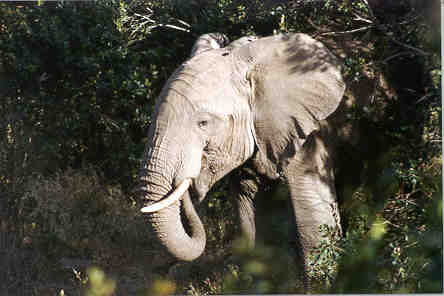
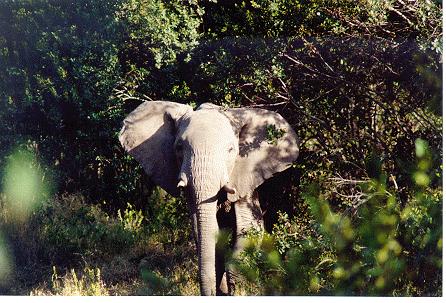
Stuart and Leslee had nice long camera lenses and immediately started clicking away. William signaled Ashley to go into the clearing to get a better view, and perhaps get in one of the shots. At this point our friend became aware of our presence and turned to have a look, resulting in the picture shown above. For a second everything simply stopped as we looked at one another. Ashley also stopped, but before we could get a nice picture of him with the elephant in the background, the elephant came to the conclusion that perhaps we represented a threat. With a great flapping of ears, he suddenly turned and started to jog in our direction. We did not need to be told what to do at this point. William was already on the run as we managed to snap off one last picture and follow him at high speed...
We did eventually find a pair of hippos but they immediately sank into the murky depths as we arrived, so no real Kodak moments there. Later after dinner, a small group of us decided to check out the local disco in Nanyuki, more out of curiosity than any desire to return to 'civilization'. The music seemed to be a mix of Afro-American rap and popular African, not that my inexperienced ear could tell you which was which. Not surprisingly, we were the only whites there, but we were soon welcomed up on the dance floor and having a great time. Indeed, the arrival of a party of very well dressed young women and one young man, backed by an entourage of spooks in suits, seemed to suggest that the President's son was also up for the party. The drive home was briefly interrupted by a large herd of buffalo crossing the road. It is amazing how such a large collection of big animals can simply disappear in the day time.
Tagged Tree Measuring - June 13
Today was fairly routine compared to the excitement of the day before. John and I were given two plots of 50 Acacia trees that had been measured and tagged the year before. Our job was to find the trees and re-measure them, noting their height, diameter at chest level, any damage, and species of ant living on and in the trees. The whistling thorn Acacia has empty pod-like galls on its branches, which often become the home of small ant colonies. In return for a home, these ants provide protection for the tree. Any disturbance to the branch, such as a browsing giraffe tongue or careless researcher's elbow, causes the ants to rush out and bite whatever comes close enough to drop on. This provides an incentive for both giraffe and researcher to move on to another part of the tree. (Acacia leaves also release tannins when disturbed - a substance that giraffes find unpleasant.) The ants can be classified by the colouring of their three part bodies. They appear to come in several combinations of red and black, but are relatively consistent by tree. So one tree might have Red Red Black, while the next tree hosts Black Black Black. All of this data is entered into the PalmPilot, using templates and note creation software developed by Jason. The software was a joy to use, but a small memory management bug meant that every once in a while (twice over the two weeks) the PalmPilot would lock up. No data was lost, but the device had to be reset by poking a small probe into a hole in the back of the casing. As it turned out, an Acacia thorn did the job perfectly, and it didn't even have to leave the tree!
Today's rhino patrol did not have much luck, but things were not entirely dull. At one point they were unintentionally chasing a rhino towards another pair of researchers on plot measuring detail - not the safest idea for either pair. We had a very brief and very light sprinkle of rain this afternoon - hardly enough to even see on the ground. They are desperately short of rain here this season. The team was saddened to learn that Kathy, Dr. Birkett's research assistant, leaves us tomorrow for another program in Costa Rica. She will be greatly missed.
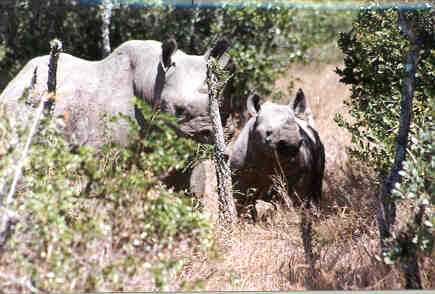
Speaking of rhino patrols, John and I were back on the job today. The patrol informed us that they had noticed fresh dung in a midden used by Job, a male, near the airstrip. When we got there, we quickly picked up his footprints along the track. There was more fresh dung at a midden used by Tivuli (female #8) and her calf, which we had not expected. We found a point at which all three black rhinos had crossed the airstrip and then doubled back to the research centre, taking advantage of the southwest wind. We headed into the southwest corner of the reserve, knowing that the rhino family would not have many travel options, and started to carefully check known bedding sites. Around 9am I was helping John through some Acacia brush when my foot stepped on and cracked a very dry twig. There was a flurry of noise slightly behind us and the guard told us to run... towards the noise! It was Job, and he was moving away from us at top speed. The tracker was the only one of us who actually saw him on the run - we saw nothing. Disappointed, we began to wander about - perhaps mother and calf were still close by. Then we got a call on the radio: another patrol had found a rhino sleeping in another sector. If we could get transport, we might arrive in time to see it. Unfortunately the research centre LandCruiser was in town. John and I said we could probably walk it, so (assuming that the message had been understood) we set off. As it turns out, the guide had not understood what we had said, and we were not headed towards the other rhino - just as well since we now learned it was at least 90 minutes away. I gave up hope of seeing a truly wild black rhino in full glory, and we set a course for home.
I have found that 'giving up' the hope of seeing wildlife in Africa sometimes works as a tactic. Sure enough, around 10:30, the guide suddenly stopped and backed us up very quickly and quietly. By now we knew what this maneuver meant. Something was clearly ahead of us. We had been passing signs of recent buffalo activity, so my initial guess was that we had come upon a herd of these aggressive and dangerous animals. A careful look however showed that the beast standing in a Euclea thicket 20 metres ahead of us was light grey and had a large horn on his nose. It was Job again, and he was directly facing us, giving me a clear view of his impressive features. Given his poor eyesight, the rhino had apparently not detected our presence, but the situation was a bit risky. Since the opening to the thicket was on the side towards us, there was a good possibility that any startling noise or smell could send him directly our way. The tracker moved off to try and find a better and safer viewing position. If we could wait until he fell asleep, it would be much easier. The tracker returned with the exciting news that Tivula and her calf were lying down behind Job in the same thicket. Three rhinos! Higher stakes and even higher risks. The guide decided we should go in one at a time for a better look. The tracker took John in first, while we waited out of sight downwind. They returned silently, John signaling that he had seen all three (barely). I was up next, and we slowly picked our way through the grass towards the bedding site. We were suddenly stopped dead in our tracks by a shrieking sound. The rhino has three primary early warning systems: smell, sound, and oxpeckers. The oxpecker is a bird that feeds on small ticks and other insects found on the rhino. In return for this meal, the bird adds its keen eyesight to the rhino's arsenal. An oxpecker had spotted us and refused to go silent again. The alarm finally registered, and as we waited, not moving, all three rhino leapt up without warning and bolted off to our right. After going in to examine the bedding site and take some measurements, we decided that we had had enough excitement for one day and were back in our huts by 11 o'clock.
My airline tickets have been found where I left them in the hotel in Arusha, but getting them couriered to me in Kenya is turning out to be a colossal headache. The level of trust on this continent is so low that they will not accept cash on delivery and they will not accept prepayment by credit card. The DHL office is insisting that I pay a local DHL representative up front, in cash, before the package even leaves Tanzania. Live and learn...
In lieu of a campfire tonight, Leslee taught a bunch of us a card game called "Spoons". It can get a bit noisy, but it is a great high energy game that anyone can play.
Sweetwaters Tented Camp - June 15
The research was uneventful today, being a repeat of the elephant damage survey of last week, but in a different location. We saw hardly any wildlife on our 11 km (7 mile) walk, which was unusual, however we have been able to gather more data than Alan had planned - clearly Team Zero (as we had come to be known, having been added at the last minute before Team 1's program) was a high performing group of individuals! After supper I was once again called upon to make the campfire go, a talent that I had apparently underappreciated. We had a chance to go to the Sweetwaters 'Tented Camp' again tonight, so I decided to check out the watering hole. On the way there, we encountered a female elephant and calf on the road (about 15 metres/yards away). A sustained revving of our engine eventually moved them off so that we could proceed.
As we arrived at the water hole, a black rhino (identified by Daniel as Tamu) and her calf came right out of the bush and wandered about the lit area for a while. Based on careful ear cut observations made by Jason and myself, we think that it was actually Shamu, another mother, but the guides always speak with such confidence, it is hard to get them to change their mind - even when additional evidence is presented. A third rhino (Otoro, male) later came along and was visible in the background. When she left, Jason and I spotted an elephant in the distance, near the road. We were amused when the resort had two night drives go right past the elephant without seeing it. Night drives involve piling participants into a safari vehicle, usually with a spotter seated in chair on the front hood of the vehicle. They are equipped with a powerful spotlight, used to initially find wildlife by sweeping the landscape and watching for reflective eyes, and also to pinpoint animals once found. That elephant later came into the lights and drank an incomprehensible amount of water for several minutes. Some waterbuck also came in quite close to us. Our game viewing was rounded out by following the bats with our own flashlights as they swooped into the beam of the big lights to gorge on the sea of insects buzzing around the lenses. All in all a fascinating night.
John and I got the day off today, so I went into Nanyuki to try and sort out my airline ticket and help Annie on the chimpanzee food shopping run. Annie has an impressive way of getting things done and inspiring people to take action. Once we returned to the reserve, I headed over to Ol Pejeta Lodge for a swim and tour of the lodge. Sweetwaters has a fascinating history, and the lodge is an important part of that. The whole reserve and ranch were originally owned by Adnan Kashoggi, the Saudi arms dealer, who had the lodge built in the 1970's. It stands as a monument to decadence: a collage of simple beauty combined with art for someone who has everything but taste. One of the outbuildings, now used as an administration office, has a lock-up with a barred door containing literally hundreds and hundreds of video tapes (along with several old VCR's). No-one seems to be sure what is on the tapes, but the buzz is that it is largely pornography, which would be in keeping with Mr. Kashoggi's reputation. The room also alleged has a trapdoor to a chamber which was once used to store a large quantity of illegal elephant tusks.
The lodge itself is a low two-story structure with large open rooms. Mr. Kashoggi's bedroom has a massive four-poster bed which is at least 12 feet wide, and is flanked by massive bathrooms and dressing rooms. The large dining room table has a longer wicker basket suspended over it which may be lowered by pulleys and ropes attached to one wall. The rumour was that at parties the basket would contain a naked girl who could be lowered down and fed, but I think the story apocryphal at best. Still, you never know about the folks in those circles - perhaps it did happen once. More believable is that Mrs. Kashoggi's bedroom has a secret escape passage for lovers when the man of the house came home unexpectedly.
The best part of the history is that everything, ranch and reserve, was lost to Tiny Rowlands, a UK magnate, in a poker game. It is all now run by Lonrho, Mr. Rowlands corporation, although it may be up for sale soon. Ol Pejeta Lodge has a lot of artwork, including modern renderings of wildlife combined with huge tusks, trophy heads, sculptures of fornicating rhinos, and an umbrella stand made from an elephant's foot. It also shows a lot of empty spaces - apparently due to pilfering and plundering by Lonrho executives. Still, we appreciated the lovely gardens and the use of the swimming pool (one of two) and tennis courts. There is also a soccer field near here which actually has the equator as the half-line - a neat concept.
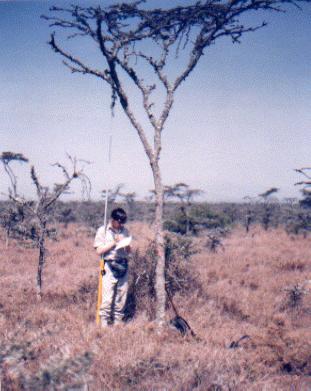
We continue to get better at gathering research data. Today we did two 5-line transects, recording data for trees, in the same time that it took us to do one set last week. We saw eland and a rhino on the drive out to our area in the morning, and 36 giraffe all in a group on the way back. Mind you, Stuart was with us in both directions, and he had already established a reputation of incredible luck on the wildlife front. My airline tickets arrived today, to my great relief, although I am now down to my last $52 US. I also got some email, which was not only great to read, but interesting to do so in the middle of a Kenyan game reserve.
The Other Volunteers - June 18
Today was a pretty easy day of vegetation plotting. We were done with the data by 11 am, so John, Kariuki, and I decided to walk the 7 km (4.5 miles) back to the research centre. We have grown so complacent about the wildlife that we chose to walk right past a sleeping rhino (Otoro) on the way home. Leslee and Marian had an exciting rhino patrol day today. They actually had to run for a tree to climb - probably the first of us to do so. Liz and Ashley also had a rough day but for different reasons. The other day they forgot to download the data from their PalmPilot after having done 266 trees. Sure enough, the next day the PalmPilot needed a hard reset and they lost all of the data. Alan had them do the trees again, and then he reassigned one of the plots to another team when some of the data did not appear consistent with previous surveys. I guess they are not a happy pair at the moment. Still, at least within the pairs, everyone seems to be getting along famously - especially Catherine and Becky, who seem well suited to each other - perhaps it's a New York thing. We may be setting records for data collection, but we must also be setting them for beer consumption. Team Zero has gotten through a phenomenal number of cases of the stuff. Personally, I'll stick to the wine, which has been okay, except for one 'box' of French red that was the worst tasting beverage of any kind that I have tasted in a very long time.
Morani II, and Campfire with Annie - June 19
John and I returned to Morani's compound today. Unlike our first day there, he remained active the whole time. We collected over 260 entries on behaviour - every movement, every change of meal. My favourite part was when a bus of about 40 tourism students from Nairobi arrived to see him. John and I were in our element, conducting a short Q & A session on Morani's history, rhino behaviour in general, and the work of the game reserve. I had some fun trying to get an extreme close-up shot of an ostrich who was wandering around the information centre. Before I left Canada, I had been given a small TellyTubby doll from a preschooler who had asked for pictures of LaaLaa doing exciting things around the world. I placed the doll on the ground near the ostrich and backed up for the shot - sort of a TellyTubby meets Big Bird theme. Had my camera not destroyed my photos, I could have at this point included a picture of a curious ostrich wandering over, picking up a (presumably) terrified yellow TellyTubby by the head and analyzing its possible nutrition value. Fortunately, the now soggy stuffed TV star was rejected. On the drive back from Morani's, we spotted Loita (a male rhino) facing us on the other side of a watering hole. We piled out to have a long look, while he remained apparently oblivious to our presence. We also encountered another elephant on the road as we neared the research compound. (Yeah, so... Can you sense how jaded we had become?)
In the afternoon, Liz and I decided to take a pair of horses from the Ol Pejeta Lodge corral and go for a horse ride. In some respects, this was the scariest thing I did while there. Stuart put it very nicely: "You're really going to go out into lion territory on the back of a four-legged bag of Meow Mix?" As always, we had a guide with us, but unlike any other occasion, this one was entirely unarmed. Add in the proliferation of aardvark holes and groves of Acacia trees with 2 inch thorns, and I began to seriously question the wisdom of my decision. I have enough experience with horses to know that they are very easily spooked, and even if it was able to outrun a lion, it would probably choose to make the attempt without me in the saddle. However, we covered a lot of ground without incident, and I was pleased with the number of intentions that I was able to successfully communicate to my mount.
Tonight's dinner table and campfire was once more graced with Annie's presence, and she started in to regaling us with more of her African film exploits. In addition to "Out of Africa", she also had great fun with the less sophisticated "Sheeba, Queen of the Jungle". Her ridgeback dog Hince(?) starred in "A Far Away Place". She has a reputation for being able track down the most the incredible things on short notice - a real talent in the remote parts of this huge continent. A few of the other volunteers went off dancing again tonight - once was enough for me.
Our last day of research activities was quite interesting. John and I were back to two more plots of "find the 50 tagged trees". The first plot was in an area that had suffered a fire the year before. There was very little medium height vegetation and the grass was very short, meaning that a lot of game was visible at longer distances and for longer times. We saw two black-backed jackals quite close, and a female rhino with calf further off, with another lone rhino beyond that (Dad?). With no bush to dart into, we were able to follow their hasty retreat for several minutes. This plot will be of particular interest to the researchers, as the vegetation returns, starting with pioneer species and then with climax species gradually taking over.
In the afternoon we had plans to visit the Kenya Safari Club - a very exclusive establishment, but a last minute visit to the club by President Moi ruled that out for us. This evening the whole game reserve staff came out and gathered around the fire with us for some closing day speeches. All of the (largely predictable) pleasantries were translated simultaneously by James into Swahili for the non-English speaking majority, who I think were largely there for the company-supplied beers. Sure enough, much beer (and wine) was consumed, and plenty of fun was had by all. One concern is for a strike of the matatu (12-seater bus) drivers, announced to begin tomorrow - our travel day. No-one is quite sure what will happen or what the effect will be on us, but we do have to use at least one of them to get from Nanyuki to Nairobi. I made my first joke in Swahili: the situation will either be hakuna matatu (no buses) or hakuna matata (no problem).
We all piled into the LandCruiser this morning, bound for Nanyuki. On the way, we stopped at a very nice wood carving studio, where a number of us picked up some great deals on beautiful wildlife sculptures. Rumour has it that the matatu strike was averted at the eleventh hour, but our connection was still a few hours late (i.e. right on schedule), which meant more shopping at the Nanyuki street stalls. As expected, the vendors, whose blankets were covered in carved animals of varying quality, were all over us to buy from them. I was down to my last 100 KSh ($1.50 US), and pointed this out to them. The nicer animals started around 2000 KSh and could usually be bargained down to about 800. Still, one particular carver noticed that I really appreciated his work and told me to pick any one - 100 KSh would be just fine! Needless to say, I spent my last 100 KSh, and got a beautiful carved rhino.
Eventually our transport arrived and we headed into Nairobi. Marian was staying there overnight, so we all dumped our gear in her hotel room and hit the stores for yet more souvenir shopping! Dinner was at the well known Carnivore restaurant with Stuart, Ashley, Leslee, Marian, Becky, and John. The specialty of the restaurant is a meat sampler arrangement, where joints of various game are brought to your table. The zebra was a bit dry, but the hartebeest had more depth. The crocodile seemed less chewy than it was in Australia, but my favourite for texture was the ostrich. I am on the same flight as Ashley and Leslee back to London, but they rushed to the airport, concerned about checking in on time, and so ended up in a different row of seats. I lost both of them shortly after our arrival in Gatwick and so made my own way to Heathrow for the final leg back to Toronto. My flight back was nothing like the flight to Johannesburg. I got a middle seat, poor service, and mediocre food, but I supposed it is better to have that at the end than at the outset. The movies were all pretty good, and I was quite happy to be back home.
 Andrew's
Home Page
Andrew's
Home Page© 1999, Andrew Welch